AI Foundations. The depth most AI training skips.
The leader who manages AI inside an organization is responsible for something the field has not figured out how to teach.
There are two kinds of AI work. Research AI lives at the frontier, asks what is possible, and publishes the papers that move the science. Applied AI lives inside the business, asks what is useful, and ships systems that have to work on Monday morning. About 20 percent of the work is research. The other 80 percent is applied. The training market has this backwards.
Most curricula are flavored like research, taught by academics or framework authors, and they prepare you to write a notebook, not to run a program.
The leader running applied AI inherits a problem nobody has solved end to end. Where the Center of Excellence sits and what it actually owns. How the org chart changes so AI is not stranded inside one function. Which metrics tell the board the program is working and which metrics tell the architects the platform is sound.
How an MVP that demos well in March becomes a production system that survives security review in June and an audit in December. How to choose between SageMaker, Vertex, Azure ML, Databricks, and the newer inference platforms when the answer depends on factors no course explains.
Applied AI is mostly seams.
Engineers learn frameworks. Leaders learn strategy decks. Architects learn patterns. Data scientists learn models. None of them learn the others, and the program fails in the seams. The model is 10 percent of the work. The other 90 percent is the organization, the architecture, the operating model, and the governance that surround it.
Each question has been written about somewhere. The connective tissue -- the part that lets you answer all of them in the same operating model -- has not. That is what this curriculum covers.
What this curriculum is
39 chapters that move from how models work, to how to build with them, to how to ship them, to how to organize teams around them, to how to govern them. Written for the leader making the decisions and the architect, engineer, or data scientist they will rely on to execute. Built from production experience across healthcare, ad tech, and platform modernization at enterprise scale.
39
Chapters
3
Free
5
Cloud Platforms
20
Enterprise Projects
40+
Hours
The three free chapters cover the foundation. The rest is the depth.
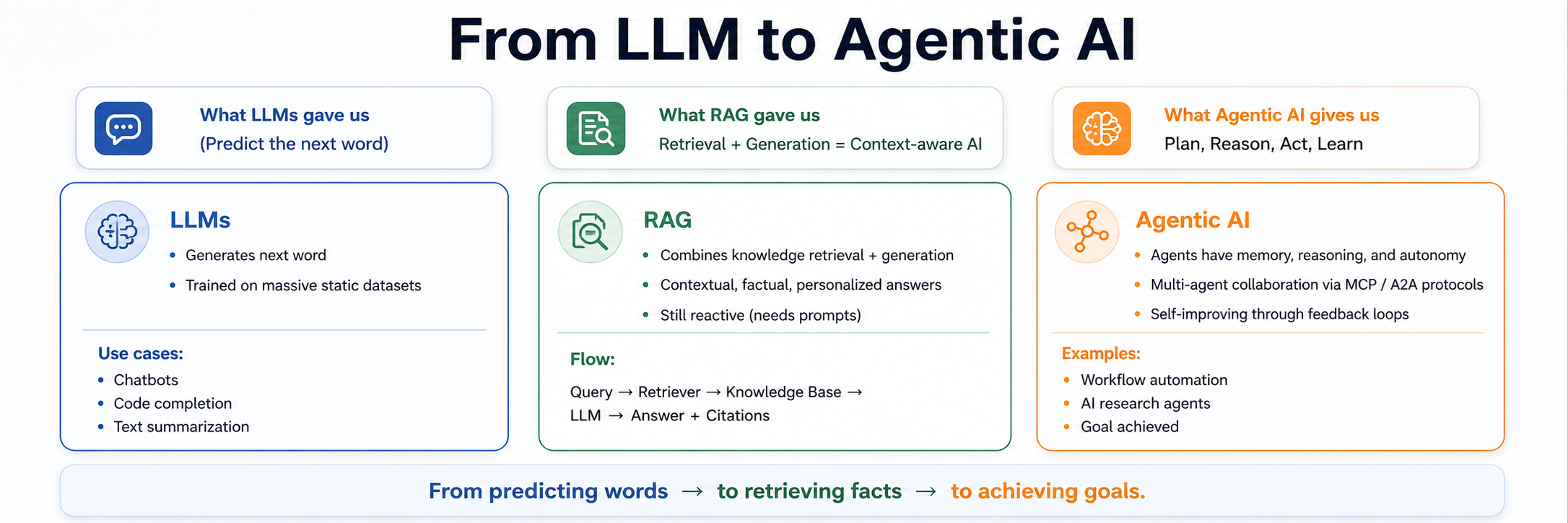
The model layer. How LLMs actually work, why RAG exists, and where agentic AI starts. Free to read. This is the floor every other chapter assumes.
Ch 1
FreeThe Foundation
How modern AI models work under the hood. GPT, transformer architecture, LLM training, the full model landscape, and key concepts.
Ch 2
FreeKnowledge & Retrieval
How AI systems store, find, and use information. RAG architecture, embedding models, vector databases, and data pipelines.
Ch 3
FreeAdvanced Intelligence
Reasoning, autonomy, and techniques that make AI smarter. Reasoning models, agentic AI, prompt engineering, and safety.
The protocol layer. MCP at depth, agentic patterns, LangChain versus LangGraph, and the integration architecture that makes agents useful instead of demo-grade. This is where most courses stop. The next sections are where the depth begins.
Ch 4
StarterIntegration & Protocols
How AI systems connect through the Model Context Protocol. MCP architecture, server/client implementation, cloud platforms.
Ch 5
StarterMCP Deep Dive
The complete guide to Model Context Protocol. Build servers, connect APIs, govern at scale. Three primitives, transports, security, tagging, and real deployments.
Ch 6
StarterBuilding AI Systems
Tools, SDKs, and putting it all together. The full SDK landscape, choosing the right stack, and production architecture.
Ch 7
StarterAgentic AI Patterns
Tool use, planning, multi-agent orchestration, human-in-the-loop, memory and persistence, agent evaluation, and production deployment patterns.
Ch 8
StarterLangChain vs LangGraph
When to use LangChain (RAG, tool-calling, summarization) vs LangGraph (AIOps, multi-agent, approval workflows, stateful agents). Decision framework, code samples, and anti-patterns.
Ch 9
StarterRAG Advanced
Advanced chunking strategies, hybrid search, reranking, query transformation, graph RAG, multimodal RAG, and RAG evaluation frameworks.
Ch 10
StarterEnterprise MCP Workflows
Build autonomous AI workflows with MCP tools, guardrails, and approval gates. AIOps RCA case study with ServiceNow, Datadog, and GitHub. Tool schemas, orchestration, and governance.
The craft layer. Production Python, prompt engineering from first principles, and the token economics that determine whether your AI product is profitable. The skills that separate a notebook prototype from a production system.
Ch 11
ProPython for AI Engineering
Production Python for AI engineers. FastAPI, async patterns, OOP for agents, testing with pytest, Docker packaging, tenacity retry, circuit breakers, structlog, and OpenTelemetry.
Ch 12
ProPrompt Engineering Mastery
Zero-shot, few-shot, chain-of-thought, ReAct, structured output, hallucination mitigation, critique patterns, agent prompts, RAG prompts, and production prompt templates.
Ch 13
ProToken Efficiency & Agent Economics
Token budgeting, early commitment patterns, deterministic replay, explore-commit-measure loops, inference cost modeling, Klarna margin analysis, and agent economics at scale.
The production layer. Containerization, async scaling, observability, MLOps end-to-end, and model packaging across ONNX, vLLM, Triton, and the serving stack. Twenty capstone projects with full source. The chapters here answer the question that breaks most AI initiatives: what does it take to actually ship.
Ch 14
ProCapstone Project
Build a complete AI knowledge assistant from scratch. Combines RAG, MCP, and agent orchestration with full source code.
Ch 15
Pro21 projects | 1,080+ tests | Interactive dashboardEnterprise AI Projects
21 full-stack capstone projects across healthcare, retail, ad tech, and operations. Python backend, React frontend, tests, architecture diagrams, and interactive notebooks.
Ch 16
ProDeploy to Production
Containerize with Docker, deploy to AWS/GCP/Azure, CI/CD pipelines, infrastructure as code, and security hardening.
Ch 17
ProAdd a Web UI
Build a polished chat interface with Next.js and Vercel AI SDK. Streaming responses, tool call rendering, and deployment.
Ch 18
ProScale with Async Processing
Task queues, batch processing, WebSocket streaming, semantic caching, and Kubernetes auto-scaling.
Ch 19
ProMonitor in Production
LangFuse tracing, continuous evaluation, alerting, A/B testing for prompts and models, and production hardening.
Ch 20
ProMLOps End-to-End
Complete MLOps lifecycle from experiment tracking to production deployment. Model serialization (pickle, ONNX, SafeTensors, GGUF, TensorRT), AWS SageMaker, GCP Vertex AI, Azure ML, Databricks, startup platforms, deployment patterns, and monitoring.
Ch 21
ProML Model Deployment
Package and deploy ML models end-to-end. ONNX, vLLM, Triton, KServe, quantization, cloud platforms (AWS, GCP, Azure, Databricks), and startup inference platforms.
The training and inference layer. Data labeling economics, post-training alignment, LoRA and DPO with GPU infrastructure trade-offs, and a healthcare AI deep dive including FDA framework and surgical robotics. The chapters most consumer AI courses cannot write because they require domain experience to teach honestly.
Ch 22
ProLLM Training Lifecycle
Data labeling at scale (Scale AI, Surge AI), pre-training on trillions of tokens, SFT, post-training alignment (RLHF, DPO, GRPO, Constitutional AI), safety, red teaming, and deployment.
Ch 23
ProLLM Fine-Tuning Strategy
When to fine-tune, when not to, LoRA/QLoRA deep dives, DPO, RLHF, distillation, GPU infrastructure (rent vs own vs API), healthcare case study, team organization, and complete medical model code walkthrough.
Ch 24
ProLLM Inference & Healthcare AI
NVIDIA dominance, AMD's rise, Intel's struggles, GPU selection, surgical robotics (da Vinci 5), healthcare AI, data centers, and the shift from training to inference.
Ch 25
ProHealthcare AI
Surgical robotics (da Vinci 5), radiology AI (258 FDA devices), FDA regulation (PCCPs, SaMD), medical fine-tuning, ambient documentation, drug discovery, genomics, and edge inference.
The organizational layer. How to structure the AI function, where the Center of Excellence belongs, what twenty real enterprises have actually built, and how Claude deploys across the four surfaces and six layers of a working enterprise stack. Written for the leader making the decisions and the architect briefing them.
Ch 26
ProEnterprise AI Organization
Build the teams, data foundations, and operating model for AI at scale. Org models, department taxonomy, CoE, roles, and maturity.
Ch 27
ProClaude Enterprise Enablement
Deploy Claude across your organization. Four surfaces, six-layer stack, governance, metrics, and real deployment case studies.
Ch 28
ProEnterprise AI Case Studies
Deep org structure analysis of 20+ companies across financial services, tech, healthcare, and consulting. Cited sources, leadership profiles, and lessons learned.
Ch 29
ProAI for Business Leaders
AI strategy, ROI measurement, build vs buy decisions, vendor evaluation, change management, AI roadmaps, and board reporting.
The regulatory and risk layer. Prompt injection, model extraction, EU AI Act, GDPR, HIPAA, and the compliance frameworks that determine whether your AI program survives audit. The part of AI that gets you fired if it goes wrong.
Ch 30
ProAI Security & Red Teaming
Prompt injection, data poisoning, model extraction, jailbreaks, red teaming methodologies, defense strategies, and compliance frameworks.
Ch 31
ProAI Ethics & Governance
EU AI Act, bias detection and mitigation, explainability (SHAP, LIME), responsible AI frameworks, GDPR/CCPA/HIPAA, environmental impact, and governance programs.
The platform layer. Self-assessment, learning paths, and architecture-level deep dives into AWS, GCP, Azure, Databricks, and Snowflake. Trade-offs named, not just features listed.
Ch 32
ProAI Engineer Study Guide
7 essential skills mapped to chapters. Learning paths for developers, ML engineers, and AI leaders. Self-assessment checklist and recommended progression.
Ch 33
ProDatabricks & Google Cloud AI
Databricks Lakehouse, MLflow, Unity Catalog, Google Vertex AI, BigQuery ML, AutoML, and multi-cloud AI/ML patterns.
Ch 34
ProSnowflake AI Platform
Snowpark, Cortex AI, Arctic LLM, Document AI, ML Functions, Feature Store, and Snowflake-native ML pipelines.
Ch 35
ProAWS AI/ML Platform
SageMaker, Bedrock, Titan, CodeWhisperer, Trainium, Inferentia, Step Functions, and the full AWS AI services ecosystem.
Ch 36
ProGCP AI/ML Platform
Vertex AI, Gemini, TPUs, BigQuery ML, AutoML, Model Garden, AI Platform Pipelines, and Google Cloud AI services.
Ch 37
ProAzure AI/ML Platform
Azure ML, OpenAI Service, Cognitive Services, Phi models, Azure AI Studio, Responsible AI, and enterprise deployment patterns.
Ch 38
ProData Catalogs & Table Formats
DuckLake, Apache Iceberg, Delta Lake, Hudi, Paimon, Unity Catalog, Polaris, Gravitino, metadata management, lineage, data contracts, and open table format selection.
Ch 39
ProAI Infrastructure & Hardware
GPU procurement, NVIDIA H100/B200, AMD MI300X, Trainium, Inferentia, Groq, Cerebras, data center cooling, power planning, and infrastructure strategy.
Claude Code Cheatsheet
Single-page color-coded reference for all commands, shortcuts, flags, and environment variables.
The first three chapters are free.
The rest is the depth. One-time purchase, lifetime access, free updates as the field moves.